ETCHU NORISHIGE

               Unique MATSUKAWA "Pine-bark"and UZU-MAKI HADA
               "dressed in whirlpools" has CHIKEI and JI-NIE.
               KO-MIDARE with ASHI, KO-GUNOME with valleys and
               SUNAGASHI in NIE. NIE can be large. KINSUJI.
               BOSHI:KO-MARU, KAEN, TOGARI.
               SOSHU masters come to the HOKURIKU


"The Ten Students" - See Ten Students
GOFUKU GO NORISHIGE EN-KEI 1308 (SAGAMI) GEN-KYO 1321
    |________________________ _________________________ ________
____|____                  __|_____                 ___|____    |
SHIGEKUNI(1) KEM-MU 1334   TOMONORI(1) KEM-MU 1334  MASANOBU    |
(NOBUKUNI 3: same)   ________|_____                 TEI-WA 1345 |
____|____            SAKON TOMONORI(2) TEI-JI 1362              |
SHIGEKUNI(3)           ______|_____                             |
   O-EI 1394           UDA TOMONORI(3) EI-TOKU 1381             |
                              ___________________________ ______|
________                  ___|____                   ____|____
TOMOHIRO(1) TEI-JI 1362   SANEKAGE(1) TEI-JI 1362    SUKESHIGE
___|____                  ___|_____      _________   TEI-JI 1362
TOMOHIRO(2) O-EI 1394     SHIGEKUNI(2)   MITSUMUNE
                          EI-TOKU 1381   EI-TOKU 1381

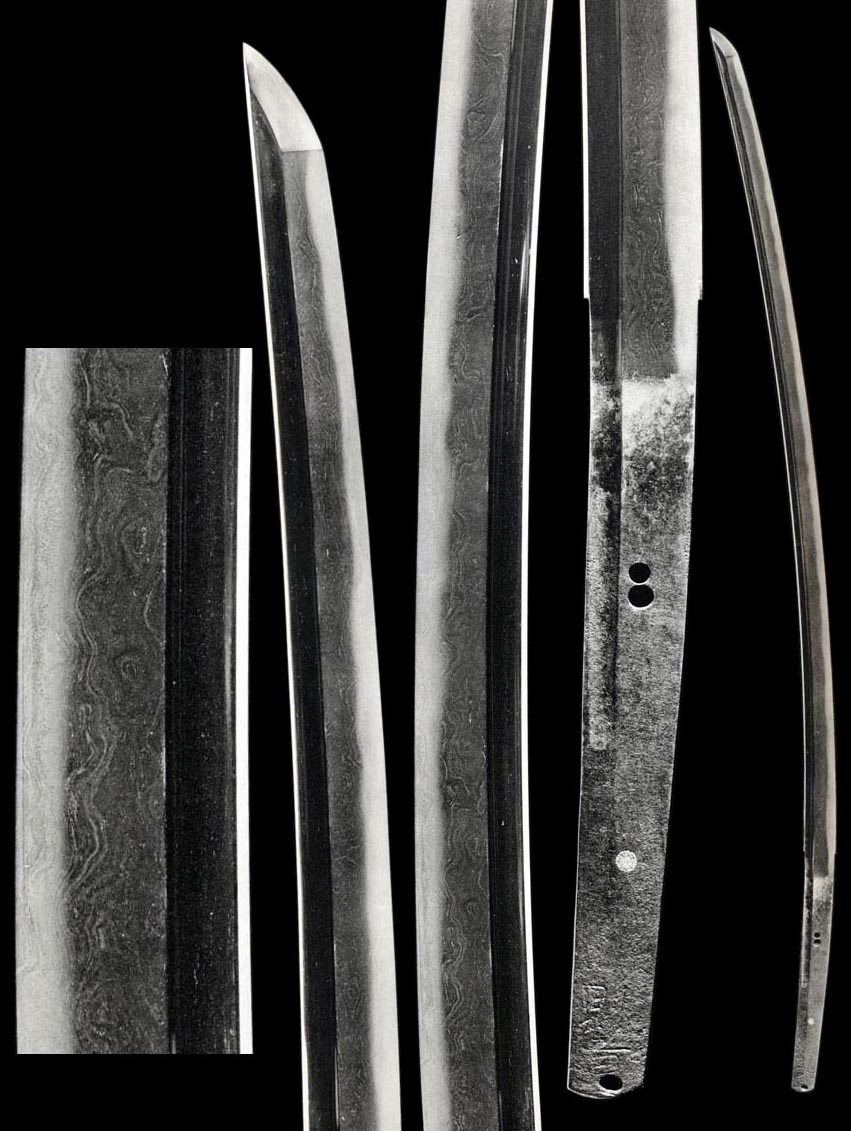
NORISHIGE EN-KEI (t:SHINTOGO KUNIMITSU): A member of the SOSHU
        revolution. Legend and old lessons has the world suckling
        MASAMUNE, whose work and reputation are stark. However
        the power and subtlety of HAMON and intricate beauty of
        his CHIKEI show the true stature of NORISHIGE as brother
        student under KUNIMITSU and his own man. Among the SOSHU
        he is ICHI-DAN - highest level. Although specializing in
        TANTO, his long-swords are thought superior.
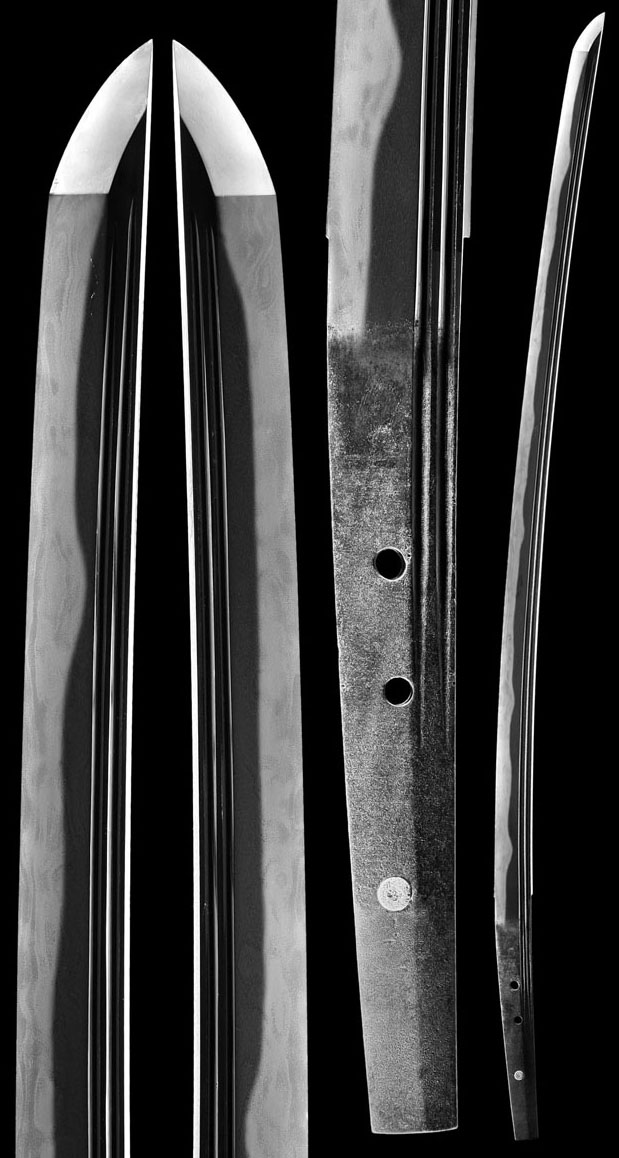
     TACHI: Signed blades are few. SUGATA is classic. Thin KASANE
        gives a longish feeling to an otherwise normal KISSAKI.
        Correct and normal NIKU. IHORI or MITSU-MUNE.
     TANTO: Curveless, 7 to 8 SUN, MITSU-MUNE or possibly longer,
        TAKENOKO-like (slightly UCHIZORI) IHORI-MUNE. Lengthening
        of the KISSAKI is seen in TANTO as well. CHIKEI defines
        UZU patterns of hard and soft steel in his unique
        MATSUKAWA-no-HADA. JI-NIE is found. He is known for a
        JI-BA style HITATSURA where small TOBIs seem to
        splatter-up into the JI. HAMON may be KO-MIDARE with
        ASHI, KO-MIDARE, or a KO-GUNOME, NOTARE mix that appears
        a dynamically balanced "Jumble." NIE GUNOME-MIDARE with
        SUNAGASHI has NIJUBA, YUBASHIRI and KINSUJI. MIDARE-KOMI
        BOSHI. KAEN,TOGARI & KO-MARU.
    MEI: NORISHIGE
         SAEKI NORISHIGE
         SAEKI NORISHIGE SAKU
         ETCHU-no-KUNI NORISHIGE
         SAGAMI-no-KUNI JUNIN NORISHIGE
         ETCHU-no-KUNI NEI-GORI GOFUKU JU SAEKI NORISHIGE
         ETCHU-no-KUNI NEI-GORI GOFUKU GO JU SAEKI NORISHIGE
 Tokubetsu Juyo Norishige
 Tokubetsu Juyo Norishige
 Tokubetsu Juyo Norishige
KOKUHO NORISHIGE              National Treasure
   NAGASA: 8.2 SUN                      MOTO-HABA: 6.6 BU
     SORI: UCHI-ZORI                  MOTO-KASANE: 2 BU
   NAKAGO: 2 SUN 6

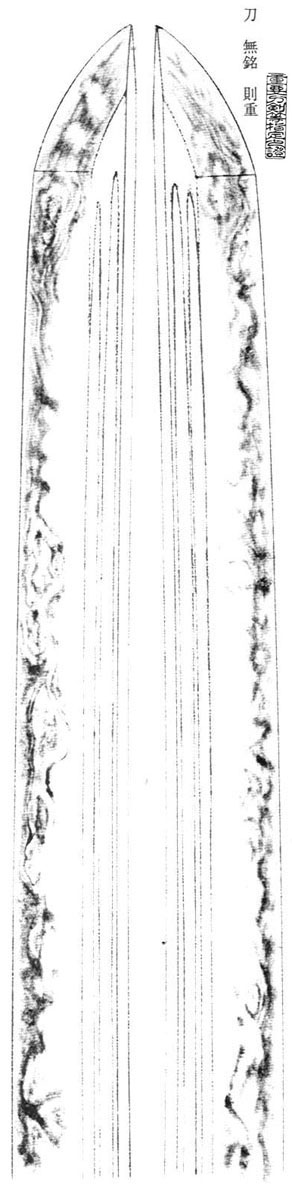
   HIRA-TSUKURI, IHORI-MUNE TANTO. SUGATA style is narrow
   with thick KASANE. MATSUKAWA "Pine-bark" ITAME HADA is
   exemplified by the strongest CHIKEI. Writhing KINSUJI and
   INAZUMA hide and seek in a NOTARE CHOJI mix that rolls
   together. Small SHIMA-BA clings in the MONOUCHI.
   His work is described as MYO, or wondrous.
   FURISODE "KIMONO-sleeve" NAKAGO with three MEKUGI-ANA of
   varied size, from multiple mountings, and his two-
   character MEI.
|
|

|
KOKUHO
NORISHIGE

|
|